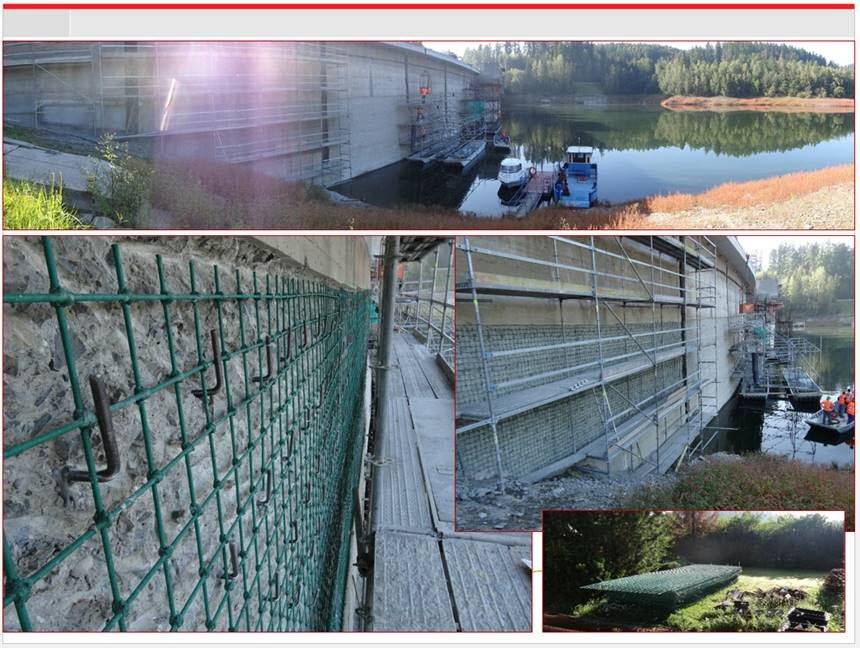
Glass fiber reinforced rebar (GFRP) can replace steel reinforcement in concrete structures. Its use can be temporary – or permanent where there are requirements for high strength, risk of corrosion or to avoid or to avoid induction of currents from electromagnetic fields.
The product is an environmentally friendly solution that significantly reduces repair and maintenance costs.
The reinforcing bars are produced by pultrusion in a continuous production process. High-quality glass fiber with polyester or vinyl ester resin is used for reinforcement. Typical fiber content of 75%.
GFRP reinforcement has twice the strength (tensile strength) compared to steel. The material has a linear-elasticity up to fracture – so-called brittle fracture. The weight is ¼ compared to steel reinforcement.
GFRP rebar is available in nominal diameters from 8 mm to 38 mm.
Angles / bends are available in various designs in 2D or 3D shapes, similar to steel rebar.

Benefits and features
- low thermal conductivity reduces thermal bridging through concrete
- Non-conductive – will not cause unwanted electrical current in the event of accidents
- Non-magnetic – does not interfere with electronic instruments
- corrosion resistant – reduces the need for concrete covering by corrosion protection
- high tensile strength – approximately double the strength of a steel rod
- Continuously profiled surface – good adhesion to the concrete
- Low weight – easy handling at the installation site

| Unit | S | P | |
| Fiber | glass | glass | |
| Resin | polyester | Vinyl Ester | |
| Application | temporary | permanently | |
| Color code | blue | gray | |
| Tensile strength | MPa | 1,000 | 1,000 |
| E-module | GPa | 50 | 60 |
| Self-weight | g/cm³ | 2,1 | 2,1 |
| Diameter | etc. | 6-45 | 6-45 |
| Elongation at break | 2.1 | 2.1 | 2.1 |
The GFRP rebar has undergone extensive testing at Sherbrooke University in Canada, a world-leading institute for GFRP reinforcement research in the construction industry. Based on test results, the product is qualified as permanent reinforcement in concrete structures.
Guidance/standards
– ACI 440.1R-15 – Guide for the Design and Construction of Structural Concrete Reinforced with Fiber-Reinforced Polymer (FRP) Bars
Dimensioning
The mechanical properties of FRP rebar differ from conventional steel rebar in several areas. This poses several challenges when developing a design methodology for concrete structures reinforced with fiberglass rebar.
General design recommendations for bending of concrete members with GFRP reinforcing bars are given in ACI 440.1R-06 (2006) Guide for Design and Construction of Structure Concrete Reinforced with FRP Bars, reported by the American Concrete Institute (ACI) Committee 440.
Applications
- Exposed structures
- Facade panels
- Renovation and reinforcement
- Building for infrastructure
- Highways
- High-speed rail
- Precast concrete
- Tunnel segments
- Mining
- Dams
Applications
- Transformer stations
- Axle rings
- Waterway engineering
- Temporary application (Soft Eye)
- Railway
- Research facility
- Foundation
- Industrial factories
- Balconies
- Sidewalk